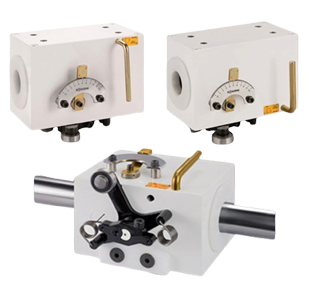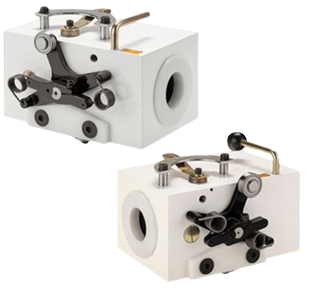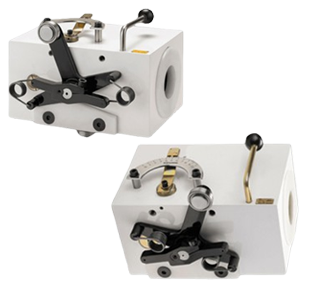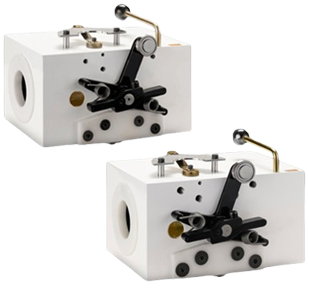

Spooling machines Layer Winding Machines Take Up Stand Wire Drawing Machine
Filament winding Machine Tools Manufacturers        
               

Wire Drawing Machine

Wire drawing is a metalworking process used to reduce the cross-section of a wire by pulling the wire through a single, or series of, drawing die(s). There are many applications for wire drawing, including electrical wiring, cables, tension-loaded structural components, springs, paper clips, spokes for wheels, and stringed musical instruments. Although similar in process, drawing is different from extrusion, because in drawing the wire is pulled, rather than pushed, through the die. Drawing is usually performed at room temperature, thus classified as a cold working process, but it may be performed at elevated temperatures for large wires to reduce forces. More recently drawing has been used with molten glass to produce high quality optical fibers

The Single/Double Deck Bull Block Non-Slip type wire drawing machines are designed for drawing of metals like Copper/Aluminium/Mild steel. The main body is made out of quality-grade cast iron. The transmission system consists of worm and worm wheel gears that are manufactured on sophisticated gear Hobbing machines. The die box is provided with two chambers for die sitting and for drawing compounds.

The spooler is either with friction clutch drive or with torque motor drive (at additional cost) for winding of drawn Bare Copper/Aluminum wire.

Process

The wire drawing process is quite simple in concept. The wire is prepared by shrinking the beginning of it, by hammering, filing, rolling or swaging, so that it will fit through the die; the wire is then pulled through the die. As the wire is pulled through the die, its volume remains the same, so as the diameter decreases, the length increases. Usually the wire will require more than one draw, through successively smaller dies, to reach the desired size. The American wire gauge scale is based on this. This can be done on a small scale with a draw plate, or on a large commercial scale using automated machinery.[1][2] The process of wire drawing improves material properties due to cold working.

Single block wire drawing machines include means for holding the dies accurately in position and for drawing the wire steadily through the holes. The usual design consists of a cast-iron bench or table having a bracket standing up to hold the die, and a vertical drum which rotates and by coiling the wire around its surface pulls it through the die, the coil of wire being stored upon another drum or "swift" which lies behind the die and reels off the wire as fast as required. The wire drum or "block" is provided with means for rapidly coupling or uncoupling it to its vertical shaft, so that the motion of the wire may be stopped or started instantly. The block is also tapered, so that the coil of wire may be easily slipped off upwards when finished. Before the wire can be attached to the block, a sufficient length of it must be pulled through the die; this is effected by a pair of gripping pincers on the end of a chain which is wound around a revolving drum, so drawing the wire until enough can be coiled two or three times on the block, where the end is secured by a small screw clamp or vice. When the wire is on the block, it is set in motion and the wire is drawn steadily through the die; it is very important that the block rotates evenly and that it runs true and pulls the wire at a constant velocity, otherwise "snatching" occurs which will weaken or even break the wire. The speeds at which wire is drawn vary greatly, according to the material and the amount of reduction.

Continuous wire drawing machines differ from the single block machines in having a series of dies through which the wire passes in a continuous manner. The difficulty of feeding between each die is solved by introducing a block between each die. The speeds of the blocks are increased successively, so that the elongation is taken up and any slip compensated for. One of these machines may contain 3 to 12 dies. The operation of threading the wire through all the dies and around the blocks is termed "stringing-up". The arrangements for lubrication include a pump which floods the dies, and in many cases also the bottom portions of the blocks run in lubricant.

Medium wire Drawing Machine

Wire drawing machine is wet slip, stepped cone type suitable for drawing non-ferrous metals like Aluminium and Copper using a numbers of dies in tandem. The machines have horizontally mounted stepped capstans which is hardened and ground finished. The drive to individual capstan shaft is provided through Helical Gears manufactured on Hobbing machines. The gear train is housed in steel fabricated solid body and is oil immersed for smooth running. The die holders are adjustable and are provided between each capstan unit. Separate pipeline is provided over each die for forced lubrication and cleaning of dies. Various models like SEW/MWD/13, SEW/MWD/11,SEW/MWD/9 to suit individual drawing requirements are available.

Fine Wire Drawing Machine

Fine Wire drawing machine is wet slip, stepped cone type suitable for drawing Aluminium and Copper wire using number of dies in tandem. The machine has horizontally mounted stepped capstans that are hardened and ground finished and mounted on antifriction bearings. The die holders are adjustable and are provided in between each capstan unit. Separate pipeline is provided over each die for forced lubrication and cleaning of dies. The main drive to the machine is by 15kW/20hp Eddy current coupling drive or DC Thyristor controlled.
We can also offer Ultra fine wire drawing machine for drawing range from 38 to 46 swg (0.152 to 0.061mm).


Copyright @ Rollring industries 2011